The Redpoll is a tiny bird, about 10 cm (5 in) long and weighing around 13 grams (0.46 oz). I have held them in my hands a couple of times when I found them in distress, and it was like holding air. Oddly (to me, anyway), they winter in cold places like Saskatchewan, where the temperature can dip beyond -40C, and spend their summers, their breeding season, in the arctic.
They are always a delight to see - one never knows whether they will show up here or elsewhere.
Lively and enduring, they are Pam and my icons for this Christmas - as well as the coming year.
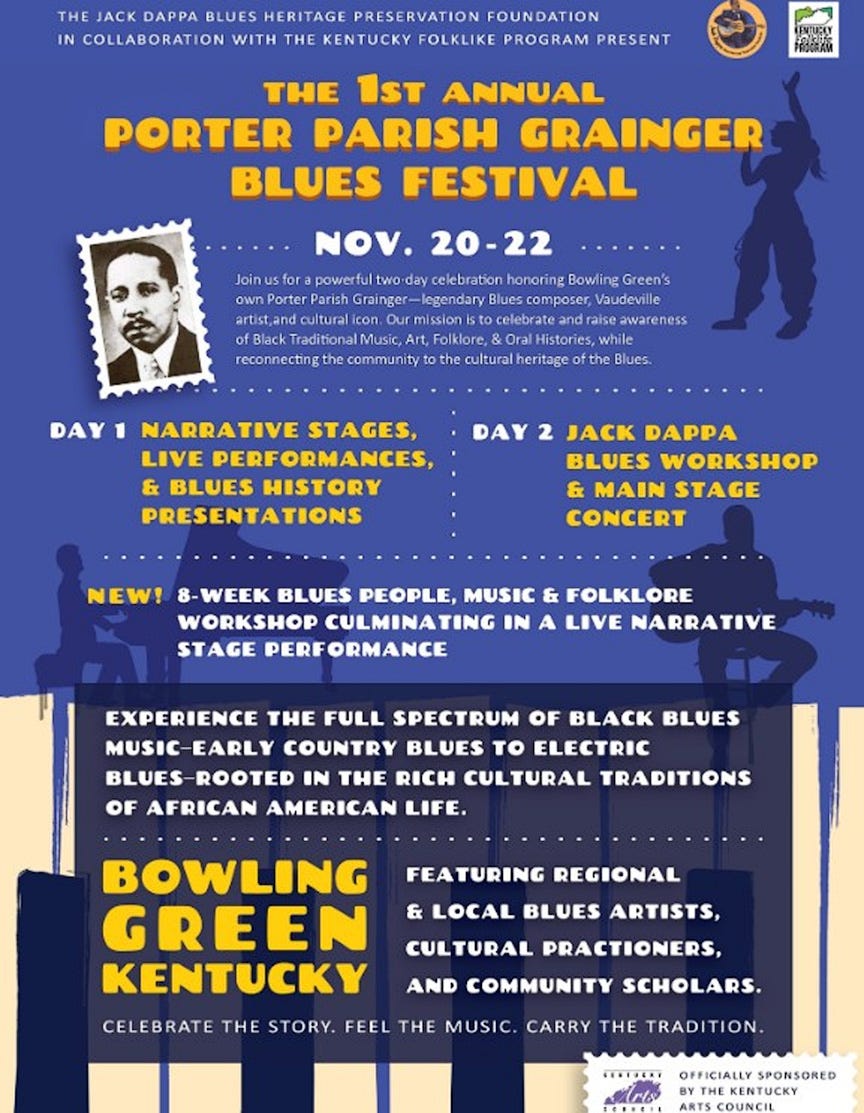
Legendary (and forgotten) songwriter of "Dyin' Crapshooter's Blues," "Ain't Nobody's Biz-ness If I Do," "Song From A Cottonfield," "One Hour Mama," and many others, finally receives attention.
Porter Grainger is one of the central characters in my book, an exploration into the origins of the song “St. James Infirmary.” My research entailed a deep plunge, and I came to consider Grainger as a force whose contributions to popular music have been so underrated that I wondered if this was more a racial than a musical bias. There was so little interest in him that, until I looked into it, both the dates and places of his birth and death were unknown.
Now, in 2025, we know that Porter Grainger was born in 1891 (seven years, for instance, before George Gershwin) that he died in 1948 (eleven years after George Gershwin). Bits and pieces of his life come into view, but they quickly fade due to lack of interest. One has to be alert in order to catch and document them.
This recognition of Grainger is past due. Many thanks to the folk in Grainger’s birthplace of Bowling Green for bringing deserved attention to this artist who has been an invisible cornerstone in the development of American popular music.
Politics do not define us. Popular Culture is our essential reference. Porter Grainger, even with the myriad mysteries that envelop his biography, remains a subterranean contributor to our sense of continuity, or even community.
Porter Grainger, as so many songwriters before and after him, revealed some of the illusions imposed by the powers of the time.
Here, as an example, is his Song From A Cottonfield, pretty adventurous for a black composer in 1927.
Grainger wrote hundreds of songs. “Dyin’ Crapshooter’s Blues” might be his most famous. It was recoded three times in 1927 (Martha Copeland - with Grainger on piano, Viola McCoy, and Rosa Henderson) and lay dormant until 1940, when McTell made the first of his three recordings. (Until recently it was assumed that Blind Willie McTell wrote the song; while researching the first edition of this book, about fifteen years ago, I uncovered this error.)
You can find the original, 1925, recordings on YouTube. There were three of them that year, no others until Blind Willie McTell. The first featured Martha Copeland.
I had been looking for this sheet music for years. Dare I say, for over a decade?! It escaped me. It was as if it did not exist. I mean, I found evidence that it was locked in the archives of the New York State judicial library, as evidence in a 1930s lawsuit. But it was rare as the Dickens and I could never find the actual thing.
But eventually I did.
I found it on eBay. The starting price was ninety-nine cents (plus postage), and there were two weeks left in the bidding. "Oh dear," I thought, "this is such an important historical document, one that has eluded me for a decade, and I am sure many people will be bidding for this, waiting for the last possible moment before entering a bid. There is no chance that, with my meager resources, I shall be able to actually get my hands on this item." But, as you can see, I did win it.
For ninety-nine cents (plus postage).
What an odd thing!! This was something of considerable historical importance. And I was the only one to enter a bid. Nobody else in the world cared. It was my golden grail. Nobody else cared. There were no other bids. And so I now possess a great historical document at a cost of ninety-nine cents (plus postage).
I must be deluded. I had been pursuing this story, this history of "St. James Infirmary," for a very long time. One of the critical links in the saga of this song appeared for sale, and . . . well . . . it sold for ninety-nine cents.
I shall have to ponder this.
Maybe history depends upon who writes the story.
The year on this music sheet is 1925. It was published by Phil Baxter in Little Rock, Arkansas. My earlier research had informed me that "Harry D. Squires, Inc." was the original publisher of this song, and that Squires was the person who convinced Fess Williams to record it (the first recorded version). So it is likely that Baxter released this edition of the sheet music before finding a bona fide publisher. Also, I had noted that Baxter and Moore neglected to copyright the song (thereby leaving the way open for "Joe Primrose" to take ownership of it). But "International Copyright Secured" is printed on these pages. I had found no evidence of this when I contacted the U.S. copyright offices, so I am not sure what this means.
The 1925 sheet music with lyrics can be found here - the pages should expand when you click on them. I leave it to you to compare this music with the second oldest publication of this song in Carl Sandburg's "American Songbag," published in 1927. Whatever this comparison tells you, it will be clear that neither Phil Baxter nor Carl Moore nor Joe Primrose nor anybody else, wrote "St. James Infirmary."
Well, it seems I'm on a Porter Grainger (or maybe a Bob Dylan) run.
So ... here's the latest.
In March, 1962, about the same time his first album was released, Bob Dylan served as a backup musician, playing harmonica, for an album featuring blues legends Victoria Spivey (b. 1906), Big Joe Williams (b. 1903), Roosevelt Sykes (b. 1906), and Lonnie Johnson (b. 1899). The album was titled Three Kings and a Queen. Young guy, aging legends; Dylan fit right in.
1962 was a busy year for Dylan the session player. He was twenty years old, and had already served as harmonica backup for Harry Belafonte on Belafonte's 1962 release of "Midnight Special."
Harry Belafonte (Dylan, 20 yrs old, on harmonica) "Midnight Special" 1962.
He had also played harp for three songs on Carolyn Hester's self-titled third album. On the one below, Hester's interpretation of Walter Davis' (1911-1963) "Come Back Baby," Dylan's harmonica has a subdued subterranean pulse. But at around 1:50 he holds a note for twenty seconds before modulating. This young man was a creative, well-practiced instrumentalist, sensitive to the nuances of a song, sensitive to how he contributed to the whole.
Carolyn Hester, "Come Back Baby," 1961.
So, back to Porter Grainger.
The back cover of Dylan's New Morning CD features a photograph of him (standing with a guitar) beside Spivey (sitting at a piano). Spivey had often recorded with Porter Grainger accompanying on piano and occasionally backup vocals. They wrote songs together. In 1937 she recorded Porter Grainger's "One Hour Mama."
Victoria Spivey "One Hour Mama" 1937
Written by Grainger, this is a woman talking about sex. Porter Grainger was extraordinary in this way; he had an ability to emulate another's point of view.
I've always heard that haste makes waste So I believe in takin' my time The highest mountain can't be raced It's something you must slowly climb
I want a slow and easy man He needn't ever take the lead 'Cause I work on that long-time plan And I ain't a-lookin' for no speed
Etc.
Grainger did this again and again. He could grasp a female point of view and make it universal (from "Sing Sing Prison Blues," written for Bessie Smith: "Judge, you ain't no woman / And you can't understand"). He could take the perspective of a slave, and make you feel it (from "Song From A Cotton Field:" "All my life I been makin' it / All my life white folks takin' it ' / This ol' heart they jus' breakin' it...") He could communicate pride (with maybe a touch of cynicism) in black engagements in war (1919's "When Our Brown Skin' Soldier Boys Come Home From War" ... can you recall any other WW1 patriotic song with black Americans as the focus?).
He often wrote in a cabaret style popular in the '20s, but he could could take on the blues (music, rhythm, lyric), he could take on spirituals, he could take on popular music.
Porter Grainger has been forgotten.
How do we forget the composer of "Dyin' Crapshooter's Blues" and "Tain't Nobody's Business If I Do?" How do we dismiss almost everything else he wrote? (Until I wrote I Went Down to St. James Infirmary, it was assumed that Blind Willie McTell wrote "Dyin' Crapshooter's Blues.")
2025. Maria Muldaur, possibly first coming to public awareness as a member of the early 1960s Even Dozen Jazz Band, interprets songs as if she was living the lyric - this is a signal of a great singer, as it is of a great actor. Her contributions to the Americana canon are exemplary.
She released an album of Victoria Spivey songs in 2025. The title song is Porter Grainger's "One Hour Mama." Muldaur reaches deeply into formative blues throughout the album, her vocals are evocative, drawing out the nuance of the lyric, and the instrumental underpinnings could not be more sympathetic. It's also a whole lot of fun!
Maria Muldaur "One Hour Mama" 2025
So thank you, Maria Muldaur, from both me and, I am sure, Porter Grainger. (Spivey would have loved this!!)
You can find more selections from Three Kings and the Queen on-line. The LP was originally released on Spivey Records, co-founded by Victoria Spivey and jazz historian Len Kunstadt. Spivey died in 1976, and the label ceased production after Kunstadt's death twenty years later. Occasionally reports emerge that the music has been re-engineered, and the label is about to be revived, but nothing materializes. Used copies can be found via sites like Discogs.