Quite by accident, my research into the long history of the song "St. James Infirmary," has become entangled with copyright.
Essentially, copyright is meant to reward the creator "for a limited time" before returning the creation to the commons, where others can use it for building the future. That is, nothing (songs, sewing machines ...) is created out of nothing - we all depend upon what went before. And we all build upon the past. There is no unique creation. But ...
Corporations want to protect what brings them money. And so, successfully, they have pressured governments to lengthen copyright restrictions.The more lengthy and restrictive the copyright laws become, the more impoverished do we all become as creators, or even just as listeners/viewers/readers ...
This contemporary notion of monetization has become an infectious illness.
Thanks, Rick, for your post!
When I began research into the history of "St. James Infirmary," it was obvious that Porter Grainger would become a major character in the book. It wasn't long before I came to the realization that Grainger is one of the great-but-forgotten songwriters of the early 20th century.
1939 photo of black musicians/composers in Harlem. (Click on the image to enlarge.)
Until I looked into census records, his birth date was unknown. Not because it was hidden, but because interest in him was so low that nobody had bothered to look.
Still, here he is in a 1939 photograph of major black composers/musicians in Harlem. Jelly Roll Martin, Eubie Blake, Kay Parker, Perry Bradford, James P. Johnson ... Porter Grainger (right of photo, beside Claude Hopkins in the white suit).
Death Certificate for Porter Grainger
Gradually he sank out of sight. He remains in the pantheon of the forgotten.
It was long thought that, due to dating of copyright renewals in his name, Grainger died in New York between 1951 and 1955. In fact, he died on October 30, 1948. (A genealogy researcher who goes by the name ladylorax recently unearthed the death certificate on ancestry.com.)
When the certificate was completed, his name was entered as "Porter, Granger" (that is, Granger Porter)—hence the difficulty in finding the record. He was living at 1300 Wylie Avenue in Pittsburgh, Pennsylvania. He was brought to the Passavant Hospital at noon, where he remained for twenty minutes (which suggests he was DOA). Cause of death was written as "Pneumonitis, due to dentures lodged in his trachea." In other words, he choked on his dentures. He was 57 years and 9 days old.
This caused me to reflect – in a roundabout way – that musicians are sometimes stimulated to write songs about ... Bob Dylan. Here are three of those songs – two of which ask "What if I was Bob Dylan?"
1. In 2010 the Italian musician, Roberto Tardito, released a song in both Italian ("Se Fossi Dylan") and English ("If I Were Dylan").
Towards the end of "If I Were Dylan" Tardito sings:
I'd have a long story to tell, a hard long story Of money, women, disillusion A secret longing to go far away To walk on distant paths, never trodden before If I were Dylan I'd not speak any more I'd not speak any more
Alas, I could find no computer link (including Spotify) for either the Italian or the English recordings. However, about fifteen years ago I bought an mp3 of the song. Blogger does not permit the loading of audio files. But Substack does, and you can find this rarity by travelling to my Substack version of this post. Click here.
2. In 2010 Cade and the Taliesins released the song "If I Was Bob Dylan" on their album The Spiral. Cade and the Taliesins is, again, close to impossible to find information about (although their album is on Spotify). The band is probably from the U.S. and is brainchild of Cade Johnson. Do they still exist? Who is Cade Johnson?
In the opening of "If I Was Bob Dylan," a love song, Cade sings:
If I was Bob Dylan I would write a new song everyday If I could be your Bob Dylan I would speak to you in metaphors always
3. In 2008 Cat Power released "Song to Bobby" on her album Jukebox. In contrast to the above, I suspect all readers know of Cat Power, who has recently toured with her interpretation of Dylan's 1966 Royal Albert Hall concert.
In the opening of "Song to Bobby," Cat Power sings:
I wanna tell you I've always wanted to tell you But I never had the chance to say What I feel in my heart from the beginning til my dying day
There must be other songs of this ilk. Can you send your favourites?
Tardito answered (thank you Google's translator for this):
"If I were Dylan, I'd have the credit and attention to allow me to experiment, both in the studio and live, that constantly break the mold. Or rather: I am and feel like a free artist, I'm not under the control of a multinational. I don't care in the slightest what people might like or dislike, I don't try to accommodate anyone. I don't make calculations. Today I'm on this path, nothing prevents me from taking another tomorrow. Of course, if I experiment, it's under the eyes of a few; if Dylan or his colleagues do it it's under the eyes of the world."
Sometime in June, 2025 YouTube posted an entry devoted to Dylan's song "Blind Willie McTell," which went unreleased for eight years after it was recorded. The song is referred to as "a masterpiece." I am uncomfortable with the bandying about of that word, but . . . sure. The video is about 50 minutes long, and revelatory for any fan of Dylan's music.
Pam and I encountered this item accidentally. One evening, after supper, we were scanning YouTube options on our TV. The algorithms (I guess it was that) steered us to an entry devoted to the complicated history essential for the evolution of that song.
At one point, early in the video, I turned to Pam and uttered, "That's I Went Down to St. James Infirmary."
Possibly 75% of the research that went into the script of this 50 minute piece came from our book.
This video is a fascinating piece of work, and I recommend it to anyone interested in the development of songs. Interested in old weird Americana. Interested in the junction between songs new and olde. Interested in something both informative and fun.
Calloway was, according to my count, the twenty-second person to record "St. James Infirmary." This was a mere three years after Fess Williams' and the Royal Flush Orchestra's initial release, then titled "Gambler's Blues," in 1927. One year after Louis Armstrong's version (recorded in 1928, released in 1929).
Cab restricted the song to the three verses that Louis Armstrong definitively recorded in 1928 (the 3rd recording of the song). Fess Williams, on the other hand, included eight verses.
As I wrote about in the book I Went Down to St. James Infirmary, other early recordings (for instance, two versions by the Hokum Boys in 1929 (4th & 5th overall)) had a much different lyric, now forgotten - but, still, obviously SJI.
Carl Sandburg's written notation - the first one ever (1927) could only scrape the surface of the many versions that were making the rounds throughout North America with solo blues singers, small and large touring bands, in fancy night clubs and sleazy bars and back porches and living rooms and brothels and street corners and music halls, before the recording studios more or less defined (and restrained) the song into the variations we hear today.
Cab Calloway, performing at Harlem's notorious Cotton Club in the 1930s, used SJI as his theme song. Until, using the same opening and the same melodic structure, he substituted Minnie the Moocher - which was based upon a "traditional" song (also documented in Sandburg's "American Songbag") titled Willie the Weeper.
This is such a small part of the story, and it's pretty recent.
(Btw I have no doubt that Michael Jackson studied Calloway's moves.)
The long history of this song is fascinating.
So, in a nod to recent history, here are two videos of Cab Calloway performing St. James Infirmary. The first is from 1947, from his movie "Hi-Di-Ho," seventeen years after his first recording of the song. (He presents the protagonist as a hopeless failure, rather than the gambler who could afford the extravagant funeral arrangements.) The second is from his 1964 appearance on "The Ed Sullivan Show," preceding The Beatles' third appearance. (You can see both of these on my blog entry from 2021.)
"The New Music of Reginald Foresythe" This was the name of his band. It was also his notion that he could influence the musical atmosphere of jazz.
Reginald Foresythe isn't a name you hear much these days. He was born in 1907, and made a splash in both the U.S. and (his birthplace) Britain in the 1920s and 30s.
He was a talented pianist and accordionist. He's probably best known as leader of a band (piano, clarinet, saxes, bassoon - no trumpets!) called "The New Music of Reginald Foresythe." He certainly saw himself as an innovator. Jazzy, but not jazz. Well, jazzy with an odd, impressionistic, edge.
Popular songs of his carried titles such as "Serenade For A Wealthy Widow," "Berceuse For An Unwanted Child," "Dodging A Divorcee," "Dinner Music For A Bunch Of Hungry Cannibals," "Revolt Of The Yes-Men."
Among these was a piece titled "Deep Forest - A Hymn To Darkness #1." (Which was followed by "Lament For The Congo - A Hymn To Darkness #2.")
For this post, we are more interested in "Deep Forest - A Hymn To Darkness #1."
This was recorded only a couple of years after Louis Armstrong released his iconic version of "St. James Infirmary." The third recording of the song, Armstrong's became the template for future arrangements. And now, a couple of years after that 1929 release, we find a song using the SJI melody as a dominant feature of the piece.
Oh. That Louis Armstrong release, with Armstrong's Savoy Ballroom Five, featured Earl Hines on piano. Hines later recorded "Deep Forest," with its SJI melody, two years later. So did Paul Whiteman and his orchestra, in 1934.
Paul Whiteman was a big deal. He was the most successful popular artist of the 1920s. In that decade alone, 63 of his songs were top 40 hits. 13 of those reached #1. He is one of the biggest selling musicians in all of recorded popular music. He kept "Deep Forest" as an instrumental, disposing of Foresythe's lyrics:
At the call of day I must lay my dreams away Once again with my heavy load I'm ploddin' on the road
Oh night where can you be Please set the darkness free Toilin' all the day in life's deep forest You mean dreams and rest for weary me
SJI was recorded at least two dozen times between 1928 and 1930. But its melody was already being incorporated into new songs. Love and theft.
Reginald Foresythe - Deep Forest - A Hymn To Darkness #1
Inside cover of Denton & Haskins 1930 "St. James Infirmary." Item should enlarge if clicked on.
In this blog entry - and in more detail in I Went Down to St. James Infirmary - I write about a 1930 New York court case where Irving Mills' music company sued the music publisher Denton & Haskins.
Denton and Haskins (D&H) were selling a song, "St. James Infirmary," that Mills Music had been heavily promoting over the previous year. (These were the early days of song recording when sheet music outsold records.) While the song published by D&H had the SJI title, the lyrics were much different. D&H hired Claude Austin to write new music and William J. McKenna to write a new lyric. (D&H also included current lyrics inside the front cover; see first image.) D&H were really pushing this issue. The cover title was St. James Infirmary or The Gambler's Blues also known as St. Joe's Infirmary. These were different titles for more or less the same song. So, they were confident in their assertion that they could market a song with a title that was already in use.
Cover Denton&Haskins SJI
Mills Music argued that Denton & Haskins was taking unfair advantage of their advertising and promotion, and thereby profiting from Mills' investment in the song.
When I looked into this, the chief librarian at the New York Supreme Court kindly sent about 600 pages of testimony and legal argument. On trial and appeal Mills won the case, but when it was referred to the Appeals Court, he lost, and had to pay costs.
I had interpreted the judgements as supportive of Mills' claim, and only when I received an e-mail from a New York lawyer, Bruce R. Kraus, correcting my interpretation, did I realize that I had read the"dissenting opinion" as the court ruling.
Cover Mills Music SJI
Irving Mills did not appear in court, but submitted a signed affidavit. Among other admissions, he agreed that the song did not originate with him, or with Mills Music, or with "Joe Primrose." But since this was not a federal court, those admissions meant little as far as copyright and song ownership. As Kraus pointed out, this lawsuit served warning that Irving Mills and Mills Music were not to be fooled with; to challenge them could become an expensive proposition - Mills Music had deep pockets and were unafraid of confrontation.
Of course, this New York case was not about copyright, which is a federal and not a state matter. But, then again ... in the arguments for Mills Music, Irving was saying that I own this title, I have expended considerable effort, energy, and money in publicizing the song. It is unfair that another company gets to profit from my efforts.
Maybe it was due to this warning - the warning that Mills Music would aggressively challenge legal submissions - that the copyright for St. James Infirmary was never challenged in federal court, and Mills continued to profit from the song for many years.
As Bruce Kraus succinctly explained, "you cannot copyright a title." Copyright law considers titles or phrases to be too short; they contain insufficient creative effort to warrant copyright.
For instance, the Beatles famously recorded "The End" on Abbey Road in 1969. Two years earlier The Doors had recorded a song called "The End" on their 1967 eponymous debut
album. So did Pearl Jam (2009), Kings of Leon (2010), and quite a few others.
How many songs have been titled "I Love You"?
From Bob Dylan's 2015 MusiCares Person of the Year speech: “I learned lyrics and how to write them from listening to folk songs. And I played them, and I met other people that played them back when nobody was doing it. Sang nothing but these folk songs, and they gave me the code for everything that’s fair game, that everything belongs to everyone.” (italics extra)
"Everything belongs to everyone," Dylan said. Utopian. Undeniably true. And that's St. James Infirmary.
After the tragic event on January 1st, 2025, it seemed appropriate to post a couple of performances - each with its distinct flavour - of a song closely related to the city of New Orleans. St. James Infirmary.
Pam and I stayed with friends in NOLA a few years ago. We heard the song played everywhere; in small jazz venues, on street corners, and in food venues such as the Cafe du Monde, all in the French quarter. A grand time was had by all. It was the Jazz Festival. Streets were crowded, everyone was smiling.
First, is an award-winning Canadian band, living on a small island off the west coast, Blue Moon Marquee. Exceptionally talented, their take on St. James Infirmary.
Next, New Orleans legend Trombone Shorty. At the Obama White House.
New Orleans will always rise from turmoils visited upon it - whether storms or terror attacks.
Continuing with contemporary approaches to SJI, here are two Dee Dee Bridgewater interpretations of the song.
Bridgewater does some gender-bending in her version. She recorded this on 2015s remarkable Dee Dee's Feathers.
I have included two of her variations. Like jazz (or the blues) her approach to the song allows her musicians to have space. Space. SJI allows space for improvisation and interpretation, and Dee Dee takes advantage of that.
Debbie Burke recently interviewed me for her blog, "Debbie Burke - jazz author."
She hosts a remarkable site - I recommend checking it out! Her books can be found via amazon, and on her site.
Since she was the interviewer and I was the interviewee, there's not much I can add, except, of course, for the interview itself. So, for those of you interested in following further, here is the link:
Back in September I promised a series of contemporary interpretations of St. James Infirmary. We started with a young Rufus Wainwright. This is the second in that series and you will find two variations this time (plus a delightful interpretation of "Simple Twist of Fate").
First, David Mattson.
David Mattson on guitar
Now living in Largo, Florida, David has lived in all but one of the U.S. states, and a few other countries. He currently uses a Joe Beck alto guitar, made for him by a friend. His interpretation of SJI is a charming reimagining, with the refrain "her left hand brushing back her hair" transforming into a tender conclusion. He would use his rewritten SJI when doing soundchecks, or as an opener for gigs, allowing lots of room for improvisation.
This is a beautiful example of how SJI can be adapted by creative artists; always recognizable, always different.
Raygun Carver
Our second example.
Raygun Carver - a band name for Michael Soiseth - released his first album, "Moon Fields Yawning," in 2020. Raised around Port Angeles, he has an idiosyncratic sound, with refreshing interpretations and beautifully crafted originals. Of the latter, his "Everywhere You Go Is Where You'll Be," suggests that regardless of where we live, regardless of where we move, we remain who we are - changing the place does not change the person. Ahhhh, but maybe, changing the person can change the place?
His take on SJI is invigorating.
And, of course, not only traditional songs are open to interpretation. Raygun Carver's phrasing and timing on Dylan's "Simple Twist of Fate" opens us up for a new listen. (For instance, cue in to Carver's song at about 1:10 - "like a freight train ...")
There are so many interpretations of SJI. So many.
I am planning to post a few recent variations, starting with Rufus Wainwright. This song was recorded in 1998, part of his first album but excluded from it and re-introduced on a 25th anniversary CD.
Rufus creates a link between The Unfortunate Rake and SJI. He mixes them together as a kind of gumbo, combining lyrical touches from SJI and Streets of Laredo. Mostly, though, it's The Unfortunate Rake that he references.
The song starts: "Early one morning at the St. James Infirmary Early one morning in the month of May I spied a young cowboy all wrapped in white linen Wrapped in white linen, and as cold as the clay"
And later: "Call for the doctor, come and heal my body Call for the preacher to heal up my soul For my poor head is aching and my sad heart is breaking I'm a poor, rundown cowboy and hell is my doom"
Aside from the name of the institution (St. James Infirmary rather than St. James Hospital), this is pretty well The Unfortunate Rake - and nothing in this version, or any other version of The Unfortunate Rake, makes me think of SJI - either lyrically or melodically.
He delivers a good song.
This is not surprising: he is always brightly original, sparkling, in both his own compositions and his interpretations.
Tony Bennett in the U.S. Army, 1945. (TonyBennett.com)
Tony Bennett, who died today at 96, made his first recording seventy-seven years ago:
After a distinguished career in the army (and a short-lived demotion for eating in a restaurant with a black friend, after which he was put on gravedigging detail), Tony Bennett recorded his first song. This was "St. James Infirmary," made in 1946. The song was on a V-disc, for American troops, and never released in the U.S. George Tannenbaum explains what V-discs are:
"V-discs were recordings done for American soldiers during World War II. Because there was a musicians strike in the U.S. at the time, V-discs were recorded but they never went on sale in the States. They were only for our overseas troops. Most of the records never came home and the masters of the recordings weren't treated with any special reverence. So for years it was rare to get a hold of a V-Disc recording--especially a rare one."
Bennett became Grandmaster of the Great American Songbook, a superb stylist whose recording history extended from 1952 ("Because of You") to 2021 ("Love for Sale," with Lady Gaga).
We miss you, Tony!
You can listen to the 1946 SJI here:
And here's a more contemporary version, from 1994:
Some of the people involved in the complex and intriguing story of "St. James Infirmary."
MOMENTS BEFORE LAUNCHING INTO A PERFORMANCE of “St. James Infirmary” in 1941, jazz great Jack Teagarden referred to it as “the oldest blues I ever heard.” The first timeIheard the song, sixty years later, it sounded utterly contemporary.
I was alone in my apartment and listening to a new CD, The Finest in Jazz Vocalists. Lou Rawls was singing “St. James Infirmary.” I had been a Rawls fan as a teenager, and paid close attention. Rawls began with a mournful preamble, one that — I found out later — was written by Irving Mills in 1930 and is an infrequent addition to the song:
When will I ever stop moaning?
When will I ever smile?
My baby went away and she left me
She’ll be gone for a long, long while.
I feel so blue, I feel heartbroken
What am I living for?
My baby she went away and she left me
No no no never to come back no more.
The band picked up the tempo and launched into the body of that version of the song (there are many versions):
I went down to St. James Infirmary
I heard my baby groan
I felt so broken-hearted
She used to be my own.
Hearing that melody, I shot out of my chair and shouted into the empty room, “That’s ‘Blind Willie McTell’!” It brought to mind, with a jolt, the Bob Dylan song of that name. It’s not that the Rawls' melody was identical to Dylan's, but there were similarities. For instance, both songs use the same basic chords. Thousands of songs are based on those chords, however, so it was probably in the pulse or the phrasing that the similarities revealed themselves. I have played these two songs to friends, who often hear no resemblance. For me, it was a revelation.
Dylan recorded “Blind Willie McTell” in the spring of 1983 for his Infidels album, released in November of that year. “Blind Willie McTell” did not appear on the record, and neither did several others from those New York sessions ("Foot of Pride," "Someone's Got a Hold of my Heart"). “McTell” emerged on no official Dylan recording (bootlegs were another matter) until 1991, when Columbia released a three-CD set of alternate versions and previously unreleased material called The Bootleg Series, Volumes 1–3. This is where I first heard Dylan’s “Blind Willie McTell.”
“Blind Willie McTell” is a magnificent piece of songcraft in which both the poetry and the music carry us into broad terrain. Dylan accomplishes this not through conventional narrative, but through a series of vignettes, a cascade of images that, coupled with a compelling melody, conveys a landscape of conflict and despair. The chorus summons the musician of the title: “Nobody can sing the blues like Blind Willie McTell.” Asked why he had omitted the song from his album, Dylan said he didn’t think he had recorded it right. The first time he performed the song in concert was August 5, 1997, at Montreal’s Du Maurier Stadium, fourteen years after recording it in the studio.
Standing there, listening to Lou Rawls, I remembered Dylan’s words near the end of “Blind Willie McTell” — “I’m gazing out the window of the St. James Hotel.” Here, in a song melodically reminiscent of “St. James Infirmary,” Dylan seemed to be paying homage. I made up my mind to find out more about “St. James Infirmary.” Little did I know that this was the beginning of a very long journey, eventually leading to I Went Down to St. James Infirmary.
As a music lover (and fellow Canadian), I need to mark Gordon Lightfoot's passing. He died yesterday, May 1, at the age of 84.
"Ring Them Bells"
Most remembrances will mention "In the Early Morning Rain," "If You Could Read My Mind," "Canadian Railroad Trilogy," and so on. He wrote hundreds of songs with nary a bad one among them. I prefer to include a couple of more obscure songs. His cover of Dylan's "Ring Them Bells," and "Black Day in July," a song that was banned in the U.S. due to sensitivity over the 1967 Detroit race riots (from which the city has not recovered).
"Black Day in July"
It is difficult to overestimate Lightfoot's importance to North American folk/popular music.
You're a singular talent, Gordon! Keep on singing!!!
Gallimaufry. I'd never heard this word until I encountered the website, The Attic of Gallimaufry. The word has a French origin and derives from a kind of 16th century stew. Hash. Hotchpotch. Jumble. Jambalaya. Grab bag. Conglomeration. Pastiche ... As the site says, the entries are: "Things found by the way, Beyond the temporal horizon, Halcyon shades of kindled times."
The head page for The Attic of Gallimaufry article
All images in this entry are from The Attic of Gallimaufry. This article is heavily illustrated; you will find Janis Joplin, Carl Sandburg, Josh White, King Oliver, Jack Teagarden, Allen Toussaint, Coleman Hawkins, Washboard Leo, Django Reinhardt, Eric Clapton, and many others.
Rob Walker, founder of the first blog dedicated to SJI
The entry also features a 45-minute The Sounds in My Head program guest-hosted by Rob Walker, creator of the first-ever blog dedicated to St. James Infirmary. Here Walker presents variations of the song with a relaxed, informed commentary. This one's a lot of fun so put some time aside and give it a listen.
This is good stuff! Thank you, Attic of Gallimaufry, for your attention.
And he has a book of his own, Tempest Under Control subtitled Mit dem Mond im meinem Auge ("With the Moon in my Eye"). Although Dylan is never mentioned, he is obviously the subject of this engaging book, part biography, part fiction, part commentary.
Marco is a busy man! He is also sponsoring a live concert series, starting December 9, 2022, at the HoffArt Theatre in Darmstadt.
The first of these concerts is actually called "I Went Down to St. James Infirmary," featuring musical guests Candyjane and Lesung. There will be readings from my book.
This from Marco a few minutes ago: Your book will be part of the concerts at all dates of the series. In March, when the series continues, I will have Winfried Klima with me, who will perform "Blind Willie McTell," or in April with a Darmstadt Quartet, Hot Jazz Company, who will perform "St. James." The leader is in his 70s and has a voice like Louis Armstrong. Then, in May, Roland Heinrich takes the stage with his German Jimmie Rodgers adaptations, and so on.
That's exciting, Marco! I wish I could be there for all of them!!
The song, "St. James Infirmary" is so utterly American, so utterly Blues and Country and Jazz. It feels born in the southern U.S. And yet, and yet ... things migrate and resonate and percolate and integrate and odd things emerge from the substrate. Could the melody for SJI have originated with Norwegian gypsies in the nineteenth century?
Nicolay Gausel is a professor of Social Sciences at Universitetet i Stavanger, on the southwest coast of Norway. His studies include researching present and historical abuses of minorities.
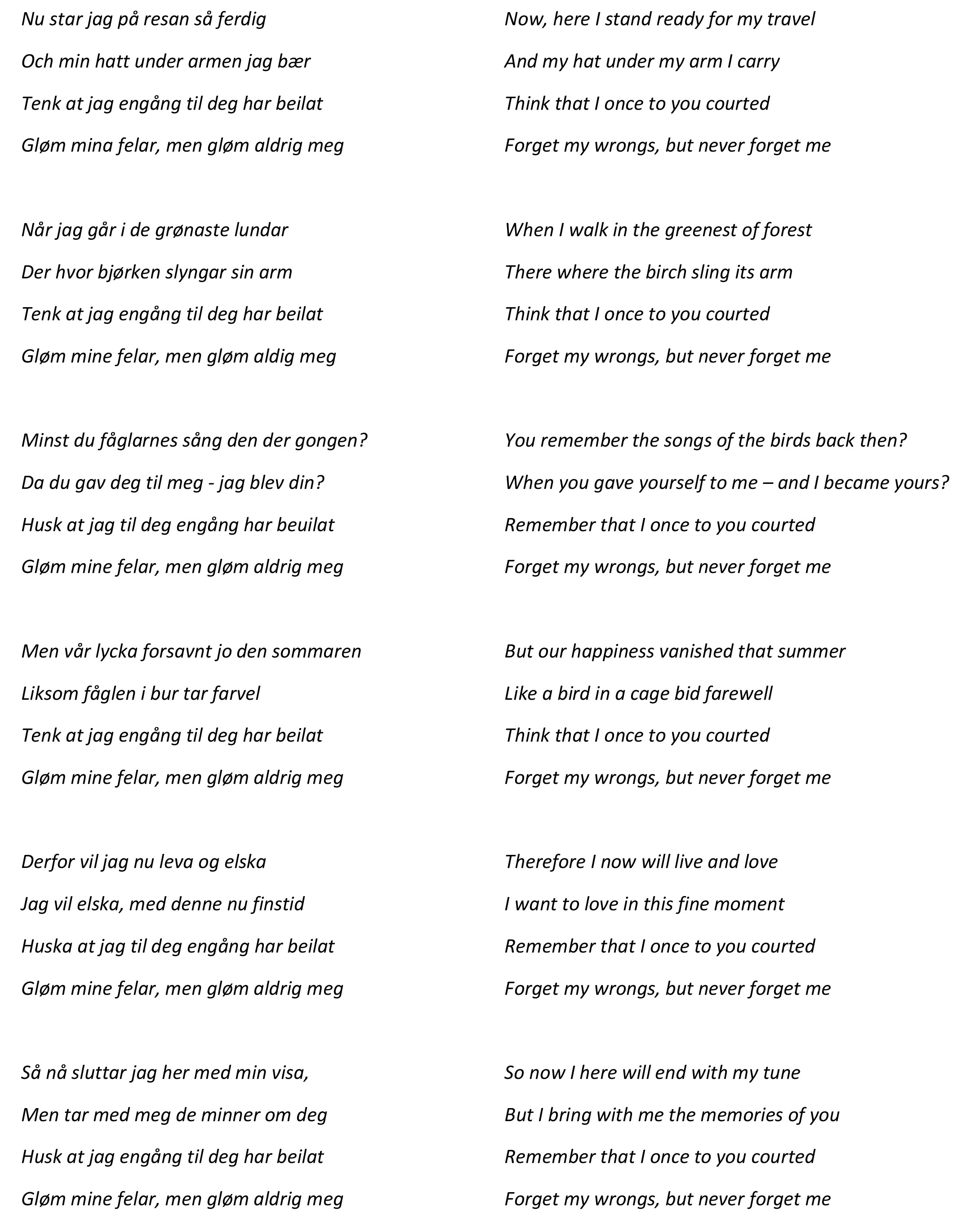
Nicolay sent us a Norwegian song, probably from the turn of the 20th century, with the St. James Infirmary melody.
He wrote: "You don't know me, but I came over some information you might like. There is some debate about the origin of the folk/jazz tune 'St.James infirmary'. I just would like to let you know that it resembles a great deal an old Norwegian/Swedish Tater song (Scandinavian word for Gypsy) entitled "Nu står jeg på resan så ferdig" ("Now here I stand ready to travel"). It's a song about a man leaving a woman he used to court, asking her to remember him but not for his faults.
"If you like to listen to the song you can find it on Spotify. It's a rare take based on a social anthropology field study to record what is left of the old Norwegian Swedish Gypsy songs. Here's the link to the song:"
Tatars is another name for gypsies. They were heavily persecuted in Norway, Sweden, and probably every other country on the planet. As lads living near Belfast, Northern Ireland, my brother and I, sixty-five years ago, climbed a grassy hill one evening and looked down at a gypsy camp. This was an extraordinary sight resplendent with colorful carriages arranged in a circle, horses reigned to posts, a fire burning in the middle of the encampment. We ran home to tell our parents and they warned us to stay away. "These are dangerous people." Our parents believed that gypsies kidnap little children. Ethnic minorities are routinely accused of horrible things, the better to justify their persecution.
In a later email Nicolay wrote: "This song is most likely from the period when Norway was in union with Sweden (1814-1905). In this period there was great emigration from Norway to the US starting in 1820 with a peak in 1860 ending around 1920. The Taters were heavily persecuted with organized hunts by hunters and local communities. So many of them would probably seek safety and a better life as far away from danger as they could get. I wouldn’t be surprised if the tune got sung on these boats crossing the Atlantic, especially since the lyric is about taking goodbye to someone dear – and the song is melancholic (like all Tater songs) so it would surely fit the situation people on the boats were in."
This melody, then, could not have travelled from North America to Norway. People were migrating in a single direction, escaping persecution, forced sterilization, murder. They had no reason to travel in the opposite direction, which would have been fatal, They were travelling from east to west. From Norway to the U.S. Bringing their songs (and melodies) with them.
Could the melody for SJI have originated with the Norwegian gypsies?
As Professor Gausel added, "I played the songs to a musician I know. He said there’s a very low chance a theme like this can be duplicated by chance."
Readers of this blog will recall that a Romany/Gypsy/Tatar version of "St. James Infirmary" was arranged by accordionist/multi-instrumentalist Michael Ward Bergeman, who recorded it with a gypsy band and then with Yo Yo Ma. He felt the melody suited the gypsy style. And maybe there is good reason for that.
The entry below features N. Gausel's translation of Nu står jag på resan så ferdig.
In the above entry Nicolay Gausel identified an old Norwegian/Swedish folk song with the same melody as "St. James Infirmary." He kindly transcribed the lyric and sent along his own literal translation of "Nu står jag på resan så ferdig" / "Now here I stand ready to travel." The song ends each verse with the poignant "Forget my wrongs, but never forget me."
Nicolay added that the lyric is in a combination of old Swedish and old Norwegian. Both songs, "Now Here I Stand Ready to Travel" and "St. James Infirmary," are about saying goodbye.
This, Nicolay says, is probably the first time the lyric has either been written down or translated.
The Wikipedia post on Irving Mills opens:"Irving Harold Mills (born Isadore Minsky; January 16, 1894 - April 21, 1985) ..."
This comes from my research into Irving Mills, during which I scoured census records and ships logs (they emigrated from Odessa). The family name in the United States was Minsky; they Americanized their names. The family can be found in the 1900 U.S. census living at 176 Essex Street in Manhattan. Many of their neighbours were fellow Russians.
BUT - regarding the name Isadore I wrote, based on that 1900 census: "Hyman (Irving's father) was thirty-four years old that June and headed a household consisting of his wife Sophia (thirty years old), and sons Jacob (eight years old) and another son of six whose name is barely legible but could have been Isidor (italics mine)."
I made a mistake writing this. First, neither Isidor nor Isadore are Russian names (although rare in the Jewish diaspora, the names are usually found in England and France). Second, as you can see from the census record (it should expand if you click on it), the writing is indistinct. All of the other family members can be clearly read (with a bit of concentration) but Irving's entry is, well, illegible.
1900 U.S. census - the Minskys are listed near the bottom at 08 (possibly meant to be 108)
I had stared at this entry for long periods. In the end I thought "the name is barely legible but could be Isidor."
Now it has become "fact" on the internet (including Wikipedia) that Irving was born Isidor (or Isadore).
From supposition to fact.
It is certainly untrue. I should have simply written that the name is indecipherable.
Irving Mills was the pseudonymous "Joe Primrose," who was given credit for writing "St. James Infirmary," the only song that has his name. Among many other clients (including Milton Berle), Mills managed the careers of Duke Ellington and Cab Calloway. He started a record company. With his brother Jack he ran one of the most successful music publishing houses of the era.
On the 1896 ship's log which brought the family to the U.S. from Odessa, when Irving was two, their names were recorded as Chaim (a hatmaker), Schifre, Jacob, and Isaac. That should have been enough.
Ps Terry Teachout in his biography of Duke Ellington, Duke: The Life of Duke Ellington, wrote "No biography of (Irving) Mills has been written. The best short treatment of his life and work is in Harwood."
Earlier this year I Went Down to St. James Infirmary was picked up by Genius Book Publishing, in the United States. Of course I became curious about other music books they are selling and bought some for myself. They have some exciting stuff! Here are a couple of examples.
Trade Mark of Quality (click here to find the book) is the most famous maker of bootleg records. The first of all bootlegs was Bob Dylan's Great White Wonder. I remember seeing that double lp, with its stark white cover and blank labels, in an Ontario record store in about 1969. "The Underground Story ..." devotes a couple of dozen pages to the creation of this album, including photographs of labelled tape reels, recording grids, etc. They devote as much attention to other Dylan bootlegs they created, plus the Stones, Beatles, Hendrix, The Who, and so on. How did they get the master tapes? How did they record live performances without getting caught? What equipment did they use? How did they adapt to a burgeoning market? All of this is recorded in minute detail in this book, including photos, news clippings, track listings, and more. At 320+ pages of a large format volume (8.5"X12"), it is a well-written and exciting read.
Tales of actual bootleg excursions are so thorough, you might think that one of the authors is the notoriously anonymous Pigman himself!
Maybe that's a question for the author of the next book.
Jim Berkenstadt is "The Rock and Roll Detective." He investigates mysteries and puzzles, secrets and hoaxes, myths and intrigue in the world of rock&roll.
What is the story behind the formation of The Traveling Wilburys? Did the Beach Boys steal a song from Charlie Manson? Who really discovered Elvis Presley? What tales lie behind Nirvana's "Nevermind" album?
Here is an interview I had with Nate Wilcox for his "Let It Roll" podcast - which aims at "putting together a history of popular music in America with a focus on the social, technological and business forces that drive the culture."
Wilcox is an engaged, very knowledgeable historian of the evolution of popular music. The interview went to some extraordinary places.
The interview is about an hour long and focuses on I Went Down to St. James Infirmary, published by Genius Books.
A friend brought this item to my attention, prefacing it with "And now for something completely different."
The musician in the video below is Hugh Levey. He writes: "My grandson quite often picks up a toy and pretends to play it like a clarinet, so last week I thought we could make a carrot clarinet together ..."
Mr. Levy runs Woodwindly, a music store in the UK. He also has a Facebook page. And he plays a darned good carrot!


%2016x12x72.jpg)


.jpg)