Friday, November 14, 2025

Porter Grainger gets a music festival!!!!!!!!!!!!!!!!

Legendary (and forgotten) songwriter of "Dyin' Crapshooter's Blues," "Ain't Nobody's Biz-ness If I Do," "Song From A Cottonfield," "One Hour Mama," and many others, finally receives attention.

Porter Grainger is one of the central characters in my book, an exploration into the origins of the song “St. James Infirmary.” My research entailed a deep plunge, and I came to consider Grainger as a force whose contributions to popular music have been so underrated that I wondered if this was more a racial than a musical bias. There was so little interest in him that, until I looked into it, both the dates and places of his birth and death were unknown.
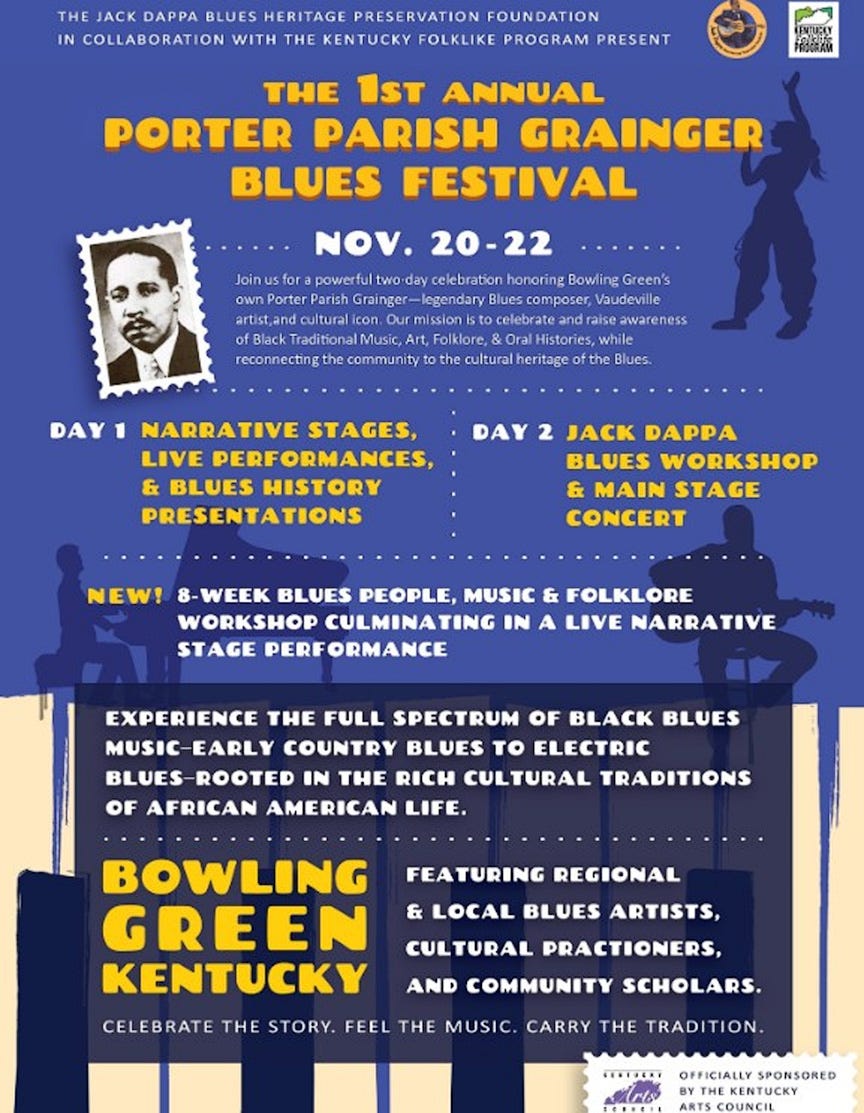
Now, in 2025, we know that Porter Grainger was born in 1891 (seven years, for instance, before George Gershwin) that he died in 1948 (eleven years after George Gershwin). Bits and pieces of his life come into view, but they quickly fade due to lack of interest. One has to be alert in order to catch and document them.

This recognition of Grainger is past due. Many thanks to the folk in Grainger’s birthplace of Bowling Green for bringing deserved attention to this artist who has been an invisible cornerstone in the development of American popular music.

Politics do not define us. Popular Culture is our essential reference. Porter Grainger, even with the myriad mysteries that envelop his biography, remains a subterranean contributor to our sense of continuity, or even community.

Porter Grainger, as so many songwriters before and after him, revealed some of the illusions imposed by the powers of the time.

Here, as an example, is his Song From A Cottonfield, pretty adventurous for a black composer in 1927.

Grainger wrote hundreds of songs. “Dyin’ Crapshooter’s Blues” might be his most famous. It was recoded three times in 1927 (Martha Copeland - with Grainger on piano, Viola McCoy, and Rosa Henderson) and lay dormant until 1940, when McTell made the first of his three recordings. (Until recently it was assumed that Blind Willie McTell wrote the song; while researching the first edition of this book, about fifteen years ago, I uncovered this error.)


You can find the original, 1925, recordings on YouTube. There were three of them that year, no others until Blind Willie McTell. The first featured Martha Copeland.


Wednesday, October 8, 2025

The Golden Grail - found! Gambler's Blues (aka St. James Infirmary), the first sheet music


 Ahhhh.


I had been looking for this sheet music for years. Dare I say, for over a decade?! It escaped me. It was as if it did not exist. I mean, I found evidence that it was locked in the archives of the New York State judicial library, as evidence in a 1930s lawsuit. But it was rare as the Dickens and I could never find the actual thing.

But eventually I did.

I found it on eBay. The starting price was ninety-nine cents (plus postage), and there were two weeks left in the bidding. "Oh dear," I thought, "this is such an important historical document, one that has eluded me for a decade, and I am sure many people will be bidding for this, waiting for the last possible moment before entering a bid. There is no chance that, with my meager resources, I shall be able to actually get my hands on this item." But, as you can see, I did win it.

For ninety-nine cents (plus postage).

What an odd thing!! This was something of considerable historical importance. And I was the only one to enter a bid. Nobody else in the world cared. It was my golden grail. Nobody else cared. There were no other bids. And so I now possess a great historical document at a cost of ninety-nine cents (plus postage).

I must be deluded. I had been pursuing this story, this history of "St. James Infirmary," for a very long time. One of the critical links in the saga of this song appeared for sale, and . . . well . . . it sold for ninety-nine cents.

I shall have to ponder this.

Maybe history depends upon who writes the story.

The year on this music sheet is 1925. It was published by Phil Baxter in Little Rock, Arkansas. My earlier research had informed me that "Harry D. Squires, Inc." was the original publisher of this song, and that Squires was the person who convinced Fess Williams to record it (the first recorded version). So it is likely that Baxter released this edition of the sheet music before finding a bona fide publisher. Also, I had noted that Baxter and Moore neglected to copyright the song (thereby leaving the way open for "Joe Primrose" to take ownership of it). But "International Copyright Secured" is printed on these pages. I had found no evidence of this when I contacted the U.S. copyright offices, so I am not sure what this means.

The 1925 sheet music with lyrics can be found here - the pages should expand when you click on them. I leave it to you to compare this music with the second oldest publication of this song in Carl Sandburg's "American Songbag," published in 1927. Whatever this comparison tells you, it will be clear that neither Phil Baxter nor Carl Moore nor Joe Primrose nor anybody else, wrote "St. James Infirmary."

Again, here is the sheet music for Baxter/Moore’s “Gambler’s Blues.”

Inquiries into the early years of SJI